
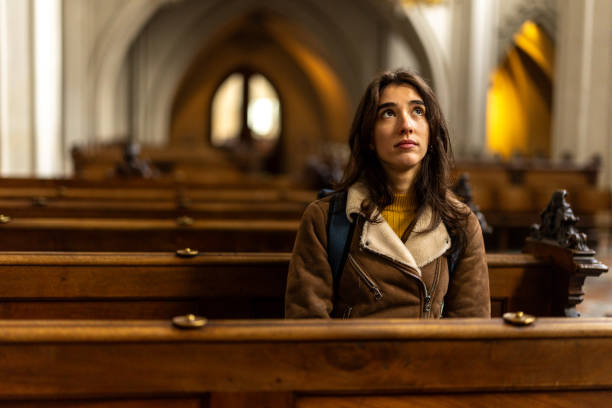
During their engagement, Jo made one thing perfectly clear.
Her relationship with Christ was the foundation of her life, and she wanted the same foundation for her marriage.
She dreamed of a husband who would pray with her, study Scripture together, lead their future children spiritually, and faithfully serve alongside her in the local church.
David assured her that he wanted those same things.
Although he had drifted away from church during college, he promised Jo that once they were married, their faith would become a central part of their lives.
Jo believed him.
Soon after their wedding, they joined a local church.
Unfortunately, that was about as far as their spiritual journey together went.
Jo quickly realized that David never suggested praying together.
He showed little interest in reading Scripture or discussing spiritual matters.
Many Sunday mornings became a struggle as she repeatedly urged him to get out of bed and get ready for church.
Even when he attended, David appeared distracted and disengaged.
Hoping things would improve, Jo encouraged them to join a couples’ Bible study.
David reluctantly agreed, but he rarely participated and made little effort to build relationships with the other men.
Months became years.
Jo’s disappointment slowly turned into resentment.
Eventually, David stopped attending church altogether.
Sunday mornings became golf mornings.
Feeling lonely, discouraged, and spiritually abandoned, Jo met with their pastor.
After listening carefully, he asked if David would be willing to meet with him privately.
To David’s surprise, the pastor spent very little time talking about church attendance.
Instead, he suggested marriage counseling.
Jo’s Story
Jo described herself as deeply disappointed.
She wasn’t asking David to become a pastor or Bible scholar.
She simply wanted a husband who would pursue Christ alongside her.
Instead, she often felt spiritually alone.
The loneliness became especially painful during major life decisions.
She longed to pray together, seek God’s wisdom together, and experience the joy of growing spiritually as husband and wife.
Instead, faith became something she practiced alone.
As the years passed, Jo noticed another change.
The disappointment she once carried gradually hardened into resentment.
Without realizing it, she became emotionally distant.
Affection declined.
Conversations became increasingly superficial.
The spiritual distance between them eventually produced emotional distance as well.
David’s Story
David admitted that much of what Jo believed during their engagement simply wasn’t true.
He had never intended to deceive her maliciously.
He genuinely thought his interest in church would return after marriage.
But it never did.
As counseling progressed, David acknowledged that he had agreed with Jo’s expectations because he feared losing her.
Once married, however, he found himself going through the motions.
Church felt more like an obligation than an act of worship.
The more Jo encouraged him spiritually, the more pressured he felt.
Eventually, her reminders sounded less like invitations and more like criticism.
Rather than drawing him toward God, he found himself avoiding both church and conversations about faith altogether.
The Counseling Process
The counseling process began by addressing a difficult truth.
Neither spouse could force genuine spiritual growth.
Jo could not nag David into becoming a spiritual leader.
David could not continue pretending that everything was fine while avoiding the very conversations that mattered most.
Both needed complete honesty.
David was challenged to examine the condition of his own relationship with Christ rather than simply his church attendance.
Together we explored the difference between religious activity and authentic spiritual commitment.
Jo also faced an important challenge.
Although her disappointment was understandable, resentment had slowly become a barrier to rebuilding their relationship.
She was encouraged to express her hurt honestly while allowing room for grace instead of constant criticism.
As communication improved, the couple began praying together—awkwardly at first.
There were no dramatic spiritual experiences.
Just two people taking small steps toward rebuilding both their marriage and their faith.
Can This Marriage Survive?
Spiritual differences create some of the deepest pain a Christian couple can experience.
When one spouse longs to grow spiritually while the other remains disengaged, loneliness often follows.
Yet spiritual leadership cannot be manufactured through pressure, guilt, or manipulation.
It grows out of a personal relationship with Christ.
Healthy marriages thrive when husband and wife pursue God together—not because one spouse forces the other, but because both recognize that a shared faith strengthens every part of the relationship.
The goal is not perfect spirituality.
The goal is growing together.
Outcome
Change came gradually.
David began meeting regularly with the pastor for discipleship and accountability.
His attendance at church was no longer motivated by guilt or pressure but by a growing desire to rebuild his relationship with God.
Jo noticed the difference.
For the first time in years, David occasionally suggested they pray together.
He initiated conversations about Scripture.
He became involved in a men’s Bible study and slowly developed friendships with other believers.
Jo’s resentment began to soften as she observed genuine change instead of empty promises.
Several months later, she reflected on their journey.
“I thought I needed David to become a perfect spiritual leader,” she said. “What I really needed was to know that we were walking toward Christ together.”
Their marriage survived because they discovered that the strongest spiritual leadership is not perfection.
It is humility, honesty, and a willingness to keep growing